How Long Does Thermage FLX Last? A Doctor's Answer
This is a subtitle for your new post


For most people, the tightening from one Thermage FLX session lasts around a year, and sometimes longer. The result is not a fixed date on a calendar: it builds for 2–6 months, holds for a period, then slowly fades as natural ageing continues. Doctors in Seoul and elsewhere usually suggest a yearly maintenance session to keep skin firm.
| Immediate effect | Mild firming from collagen contraction, often seen the same day |
|---|---|
| Peak result | Usually around 2–6 months after treatment |
| Typical duration | Around a year or more; results vary |
| Common maintenance | One session a year |
| Main factors | Age, skin quality, sun exposure, smoking, weight change, energy and shot count |
The three phases of a Thermage FLX result
When people ask how long Thermage lasts, they are really asking about three different stages. Understanding them helps you judge whether your result is on track.
- Phase 1: the first few days. Heat makes existing collagen fibres shorten. Skin can feel firmer straight away, though some of this early look comes from mild swelling that settles.
- Phase 2: months 1 to 6. The heated tissue starts building new collagen. This is where most of the visible tightening appears, gradually and naturally.
- Phase 3: maintenance. The new collagen stays in place for a period, then the skin continues to age at its normal pace. The improvement softens slowly rather than disappearing overnight.
Because of this slow build, judging the result at two weeks is too early. Most doctors review photos at around three to six months.
Why a doctor gives a range, not a promise
A doctor cannot tell you that your result will last exactly twelve or eighteen months. Collagen production differs from person to person, and the body keeps ageing after treatment.
A useful way to think about it: Thermage FLX does not stop the clock, it sets it back a little. If you compared yourself with an untreated version of yourself, many people would still look firmer even after the visible peak has passed. That is one reason yearly upkeep is popular.
What makes results last longer
- Starting at the right stage. Mild to moderate laxity responds best. Skin that still has some elasticity tends to hold its result better.
- Daily sun protection. UV exposure breaks down collagen. Sunscreen every day is one of the simplest ways to protect your investment.
- Not smoking. Smoking reduces blood flow to the skin and speeds up collagen loss.
- Stable weight. Large weight changes can affect how skin sits on the face and neck.
- Good skincare. Gentle cleansing, moisturiser and, once your doctor agrees, active ingredients such as retinoids support skin quality between sessions.
- Sleep and general health. These are not miracle fixes, but they support normal skin repair.
What can make results fade sooner
Some factors cut the lifespan of a result, even with a well-performed treatment:
- Older age or thinner skin, where collagen production is naturally slower.
- Heavy sagging, where skin tightening alone was never likely to be enough.
- Too few shots or very low energy for the area treated, which may produce a lighter result.
- Non-genuine or reused tips, which may not deliver energy as designed.
- Strong sun exposure or tanning soon after treatment.
How often should you repeat Thermage FLX?
Most people repeat Thermage FLX once a year. Some with younger, firmer skin wait longer; some with more laxity prefer a regular yearly schedule to keep things steady.
Repeating too often is not usually helpful. Collagen needs months to rebuild, and the full result of one session may not be visible until around six months. Your doctor will decide timing after looking at your skin, not only the date of your last visit.
Can combination treatment extend the result?
Many clinics plan Thermage FLX alongside other treatments that act on different layers. Ultherapy Prime targets the deeper SMAS layer for lift, while skin boosters such as Rejuran or Juvelook focus on skin quality. Combining them does not guarantee a longer result, but it can address more than one cause of ageing at once.
Maintenance planning and cost in Seoul
Because Thermage FLX is usually repeated yearly, it makes sense to think about the long-term plan rather than one visit. Patients who travel to Seoul often book their maintenance around a regular trip.
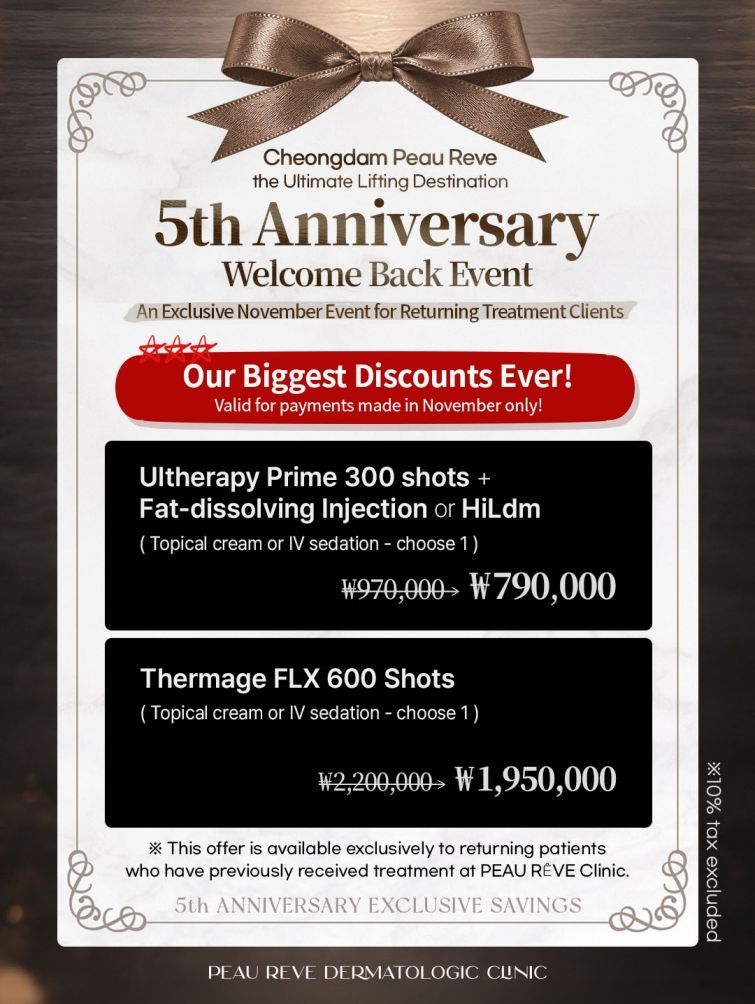
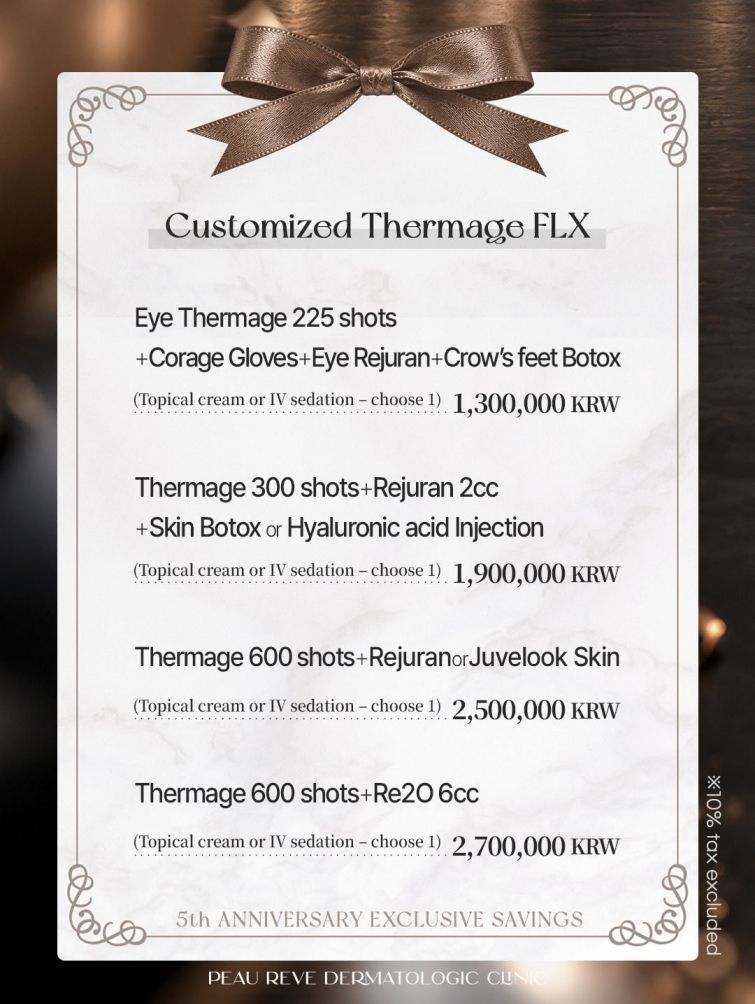
Published starting prices at Cheongdam clinics start around ₩1,300,000 for a Thermage FLX package including a booster. A Thermage FLX 600-shot session combined with Rejuran or Juvelook is published at around ₩2,500,000. Prices are excl. 10% VAT, as of late 2026; check current prices, as they change.
The shot count matters more than the headline price. A lower price with fewer shots may not compare like for like with a higher price and a full-face shot count.
Questions to ask at your consultation in Korea
- How many shots will be used, and on which areas? This affects both result and price.
- Will the sealed tip be opened in front of me? Genuine single-use tips show the shot count.
- Who will treat me? Ask whether the doctor performs the treatment themselves.
- When should I come back for review? Good clinics offer follow-up and photos to compare results.
- Is the price the same for foreign patients? Transparent clinics publish prices and charge the same regardless of nationality, and offer English support.
Frequently asked questions
How long does Thermage FLX last on the face?
For many people, the facial result lasts around a year or more. Results vary with age, skin condition and lifestyle.
When will I see the final Thermage result?
Most of the change builds over 2–6 months as new collagen forms. Doctors commonly review results at three to six months.
Is Thermage in Korea as long-lasting as elsewhere?
The device works the same way wherever it is used. What matters is a genuine tip, an appropriate shot count and an experienced doctor, whether in Seoul or at home.
What happens if I stop having Thermage?
Nothing sudden. The skin simply continues to age at its natural rate, without the extra collagen support from treatment.
This article is general information and not medical advice. Results vary between individuals. Speak to a qualified doctor about whether a treatment is right for you.